Toyota AE86 import guide
Corolla Levin · Sprinter Trueno · 4A-GE · 'Hachiroku'
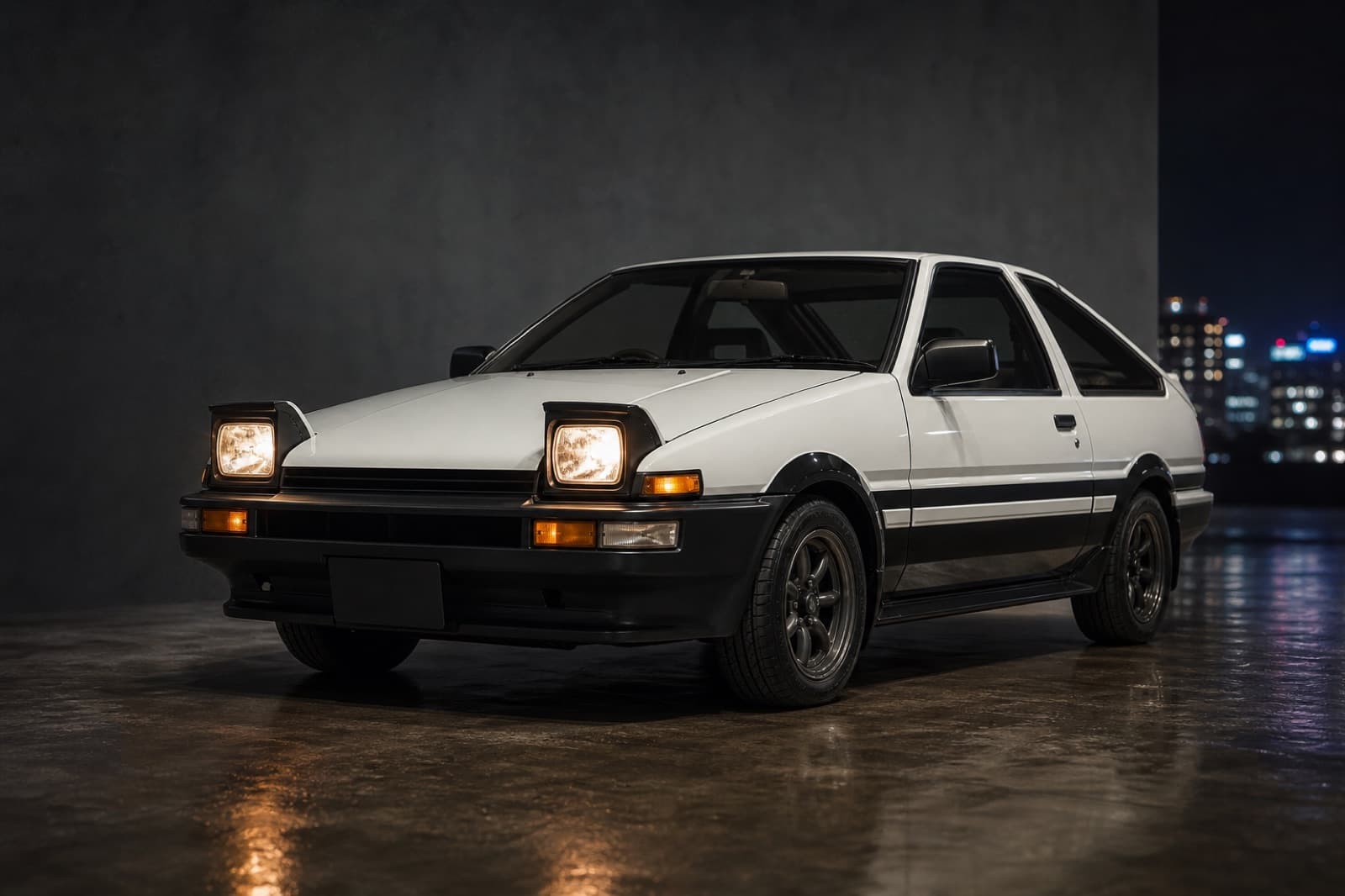
The Toyota AE86 — 'Hachiroku' — is the lightweight, rear-drive icon that defined a generation of drifting and touge culture. Powered by the rev-happy 4A-GE, the Levin and Trueno are fully import-eligible and endlessly loved. We source AE86s direct from Japan.
- 4A-GE twin-cam
- Rear-wheel drive
- Featherweight & balanced
At a glance
Toyota AE86 quick facts
- Type
- Sports coupe / hatch
- Engine
- 1.6L 4A-GE twin-cam (NA)
- Drivetrain
- Rear-wheel drive
- Body styles
- Levin (fixed lights), Trueno (pop-up lights)
- Production
- 1983–1987
- Import eligibility
- All examples are 25+ years old — fully eligible
Overview
Why import a Toyota AE86
The AE86 proves that light weight and balance beat brute power. Its naturally aspirated 4A-GE loves to rev, the rear-drive chassis is endlessly adjustable, and the whole car communicates with the driver in a way modern machinery rarely does. Motorsport and pop-culture fame cemented its legend.
As values climb, clean, honest examples are best found in Japan — where the AE86 was sold as the Corolla Levin and Sprinter Trueno.
- High-revving 1.6L 4A-GE twin-cam
- Featherweight, communicative rear-drive chassis
- Deep motorsport and drift heritage
- Fully import-eligible across all years
Variants
Levin vs Trueno, zenki vs kouki
The AE86 came as the Corolla Levin (fixed headlights) and Sprinter Trueno (pop-up headlights), each in early 'zenki' and facelifted 'kouki' forms. GT-APEX trims are the most sought-after. All were built 1983–1987, so every example is fully import-eligible today.
- Corolla Levin — fixed rectangular headlights
- Sprinter Trueno — signature pop-up headlights
- Zenki (early) vs kouki (facelift) front ends
- GT-APEX — the top trim enthusiasts seek
Buyer notes
What to look for at auction
- Rust on floors, arches, and battery tray — a known weak spot
- Originality of the 4A-GE vs engine-swapped cars
- Accident/drift history and chassis straightness
- Matching body panels and correct Levin/Trueno trim parts
- Auction grade — clean, unmolested cars command big premiums
Importing
Importing an AE86 to the U.S.
Every AE86 was built from 1983 to 1987, so all examples are well past the 25-year mark and fully import-eligible today.
Under the U.S. 25-year rule, a vehicle is exempt from FMVSS once it is at least 25 years old. Eligibility is rolling — each model year becomes importable on the anniversary of its build date.
Keep exploring
Related import guides
Toyota MR2
JDM sportsJapan's mid-engine bargain — AW11, turbo SW20, and the MR-S roadster, all light and rear-drive.
Nissan Silvia
JDM sportsThe quintessential drift car — S13/S14/S15 with the legendary SR20DET turbo.
Mazda RX-7
JDM sportsThe rotary icon — FD3S twin-turbo 13B-REW and the earlier FC and FB, light and perfectly balanced.
Toyota Supra
JDM sportsThe 2JZ legend — A80 Mk4 and A70 Mk3 with the twin-turbo inline-six that built JDM tuning culture.
FAQ
Toyota AE86 import — common questions
- What does AE86 mean?
- It's the chassis code for the rear-drive, 4A-GE-powered 1983–1987 Corolla Levin and Sprinter Trueno. Enthusiasts nickname it 'Hachiroku' — Japanese for 'eight-six.'
- What's the difference between the Levin and Trueno?
- They're the same car with different faces: the Corolla Levin has fixed rectangular headlights, while the Sprinter Trueno has pop-up headlights. Mechanically they're identical.
- Is the AE86 fully legal to import?
- Yes. All AE86s are 25+ years old and import legally under the federal age exemption. As a passenger car, state registration is generally straightforward.
- Why are AE86 prices so high?
- Motorsport fame, pop-culture status, and dwindling supply of clean examples have pushed values up sharply. Rust and engine swaps mean genuine, original cars are increasingly scarce.
- Is a Toyota AE86 street-legal in the U.S.?
- Yes — once federally cleared under the age exemption, it registers like any classic passenger car. Confirm your state's emissions and titling rules.
Import eligibility and state registration rules change over time and vary by vehicle. Confirm current requirements before purchasing. This page is informational only and not legal advice.
Ready to import a Toyota AE86?
Pacific JDMsources and finds vehicles across Japan every week. Browse what's in stock or have us source the exact AE86 you want from Japan.